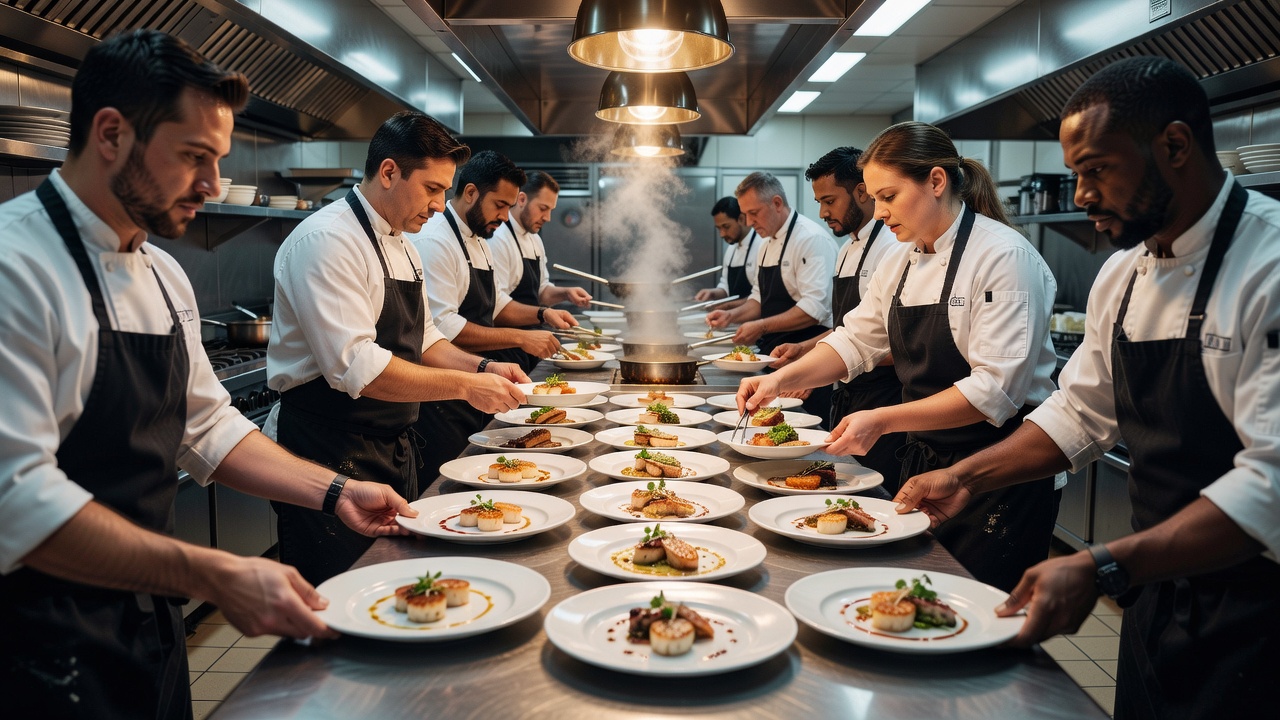
Supporting image: kitchen staff coordinating dishes at the pass.
Look beyond a single station's ticket count
A station with the most tickets is not automatically the bottleneck. Tasks differ in duration, sequence, equipment and complexity. A smaller queue of intricate dishes may require more attention than a larger queue of simple items. Workload coordination therefore needs context: what is waiting, what can proceed, what is blocking a hand-off and how much capacity the team has right now.
AI-assisted scheduling may help summarize ticket volume, predicted task duration or dependencies. Those summaries are only as useful as their assumptions. If estimated times are based on an old menu, if a station's shared equipment is omitted or if staff experience is not represented fairly, the apparent balance can be misleading. Treat indicators as prompts for a conversation, not an objective score of people.
Read a station swimlane
A swimlane is a simple way to show work by station across a timeline. Each lane can list tasks, approximate start windows and dependencies on another lane. The point is not to impose a perfect schedule on a dynamic service. It is to make waiting and collisions easier to spot before a guest is left waiting without explanation.
| Station | Illustrative queue | Watch for | Human check |
|---|---|---|---|
| Grill | Two mains; one shared finish | Equipment overlap and cook timing | Confirm actual capacity and quality check |
| Cold line | Starters and garnish | Shared ingredients or missing prep | Check availability and freshness |
| Pass | Plating and ticket hand-off | Several dishes reaching finish together | Coordinate pacing with the floor |
This illustrative table shows a way to discuss relationships; it is not a live restaurant queue or a recommended staffing level.
Follow the work through hand-offs
Many slowdowns happen between tasks rather than within one station. A garnish may be ready but the main is delayed; the pass may be waiting for a component nobody knew was blocked. A coordination view should identify the hand-off, the dependency and the next useful check. It should not simply label one lane “late” without showing why.
Agree on shared language for status. For example, “ready,” “in progress,” “waiting on another station” and “needs a manager decision” can be more actionable than an arbitrary red, amber or green rating. Keep the labels respectful and specific to the work. A person should be able to explain a blocker without being treated as the blocker.
Expect bottlenecks to move
During a service, a bottleneck may shift from the grill to the pass and then to a missing cold-line component. Once the first constraint is relieved, the next one becomes visible. A static assignment or a dashboard snapshot can therefore become stale quickly. Use short check-ins and re-evaluate the whole flow after meaningful changes rather than trying to optimize one station in isolation.
Managers can ask: Which tasks are preventing other work? Is the constraint temporary or likely to continue? Can a trained person safely assist elsewhere? Is there a quality or food-safety reason not to move work? A scheduling suggestion cannot answer these questions without the people and context present on the floor.
Coordinate without overloading people
Balancing work does not mean making every station equally busy. Some variation is useful: it can preserve room for a rush, equipment uncertainty or a difficult ticket. Reassigning tasks requires training, clear ownership and a safe hand-off. A model that tries to fill every spare minute may leave no capacity for interruptions or recovery.
Review workload information for unintended consequences. Does it reward speed at the expense of quality? Does it make a station look underused because essential cleaning or setup work is invisible? Does it compare people in ways that discourage asking for help? Improve the task model and the discussion process when the answer is yes.
Use simple coordination habits
- Brief the team on expected pressure points before the rush.
- Confirm equipment, prep availability and relevant hand-offs.
- Check the pass and affected stations when the queue changes.
- Allow the kitchen lead to override suggestions and explain the reason.
- After the shift, record the constraint and what helped resolve it.
Review the flow after service
Compare the suggested workload picture with what the team experienced. Did task durations reflect reality? Did a station wait for work that was not represented? Was help moved at the right time, and did that create a new delay elsewhere? Ask the people doing the work before deciding that a numerical measure explains the shift.
These observations help make the next plan more useful. The final link is the ability to adapt when conditions change; see how to leave room for the human call.